


The Three-Minute Claim
The average repairable auto claim in the United States takes 19.3 days from first notice to final payment. Most carriers have now automated the first ten minutes of it. A voice agent takes the statement, an app accepts the photographs, and then the claim is handed to the same process it entered in 2015: a queue for an adjuster, a wait for a shop appointment, an estimate written and re-keyed, a supervisor's approval, parts on back order, a payment batch that runs twice a week.
This POV reimagines the claims lifecycle for a world where the claim is decided upon first, and executed second. It is written for the executives being asked, after having the best margins in a decade, how are you reinvesting this to enable the customers and your claims professionals. Equally important, it paints the vision for the architects who will have to build it. This may be an ambition, but with our advancement of the existing process and continuous improvement of AI capabilities—we have the resources and vision to convert it into a near-term reality.
FNOL is a door, not a decision. Automating the front door moves the queue. It does not shorten it.
01 — The problem



The twenty-day claim
Play one ordinary claim through a typical carrier and count. A two-car collision on a Tuesday morning, rear impact, drivable, clear liability from telematics, no injury. It touches fourteen people and seven systems before it closes, and thirteen of its nineteen days are spent waiting for the next person to pick it up. Nobody in the chain is slow. The chain is long.


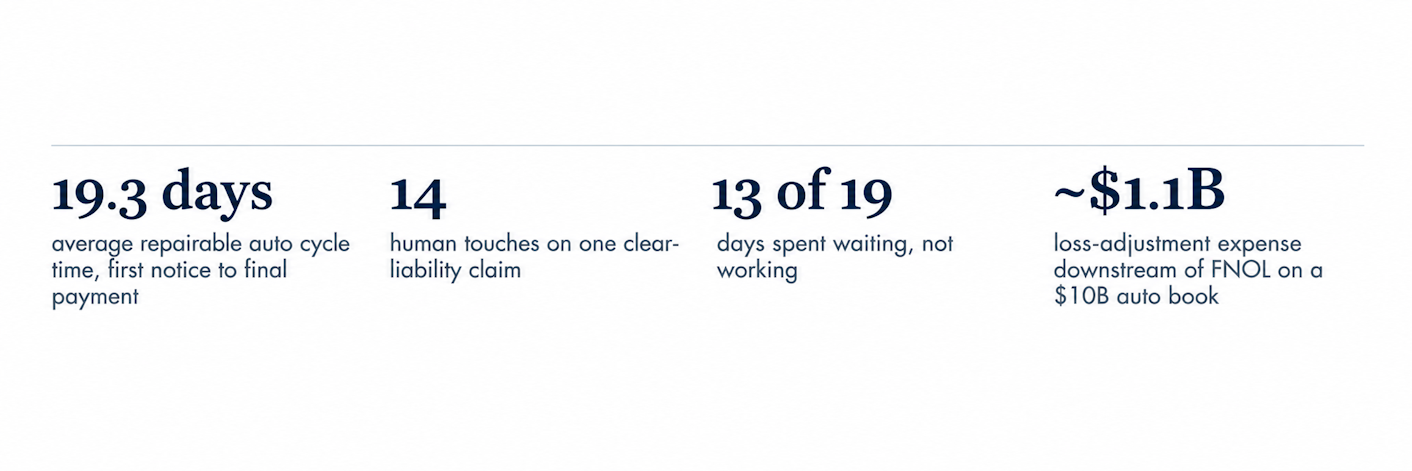
That is where the money sits. On a ten-billion-dollar auto book, roughly $1.1 billion of loss-adjustment expense is spent after first notice. Five to ten percent of claims spend leaks through overpayments, duplicate payments and missed recoveries, and fifteen percent of claims close with subrogation missed. None of it is reached by a better front door.


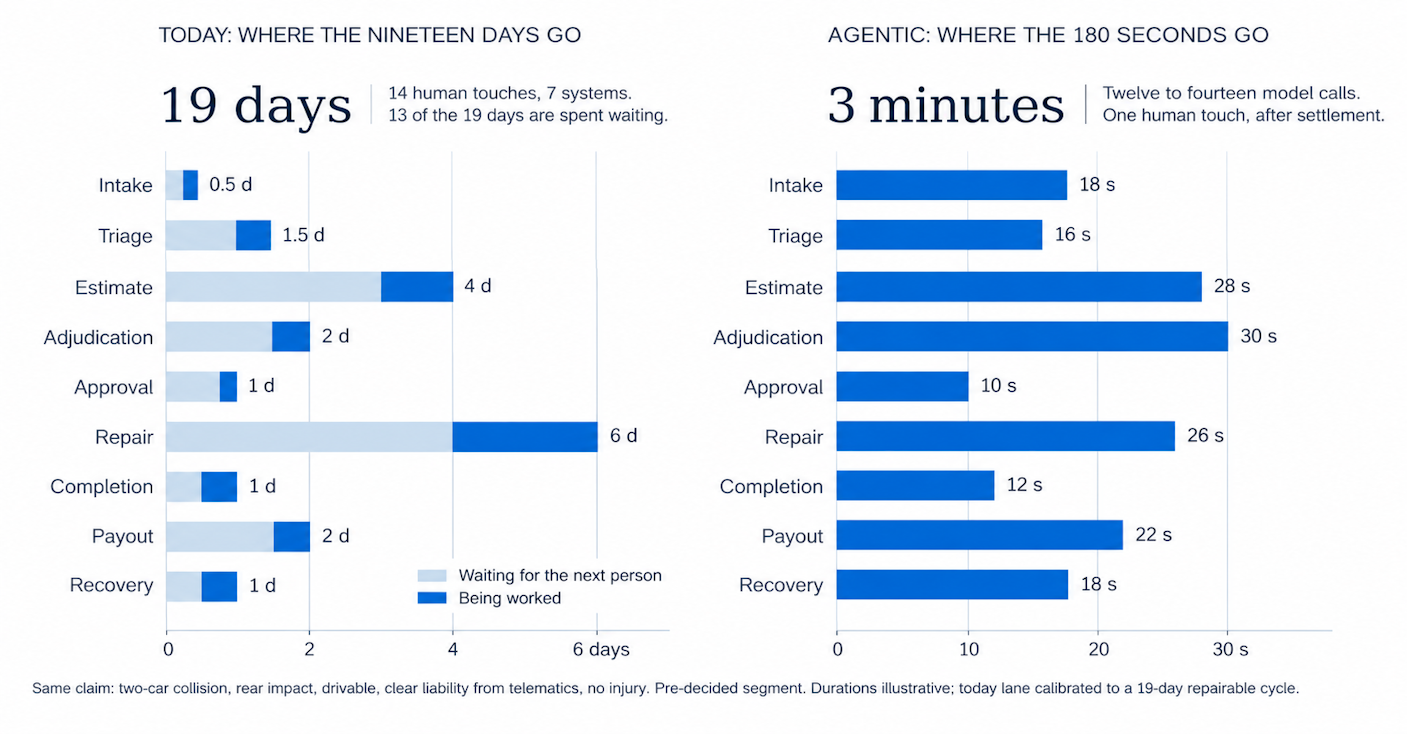
Figure 1. The same claim, twice. Today: nineteen days, fourteen touches, most of it waiting. Agentic: 180 seconds across nine stages, one human touch after settlement.
The clock also runs against the carrier in ways it does not see. Seven in ten auto-injury claimants consult an attorney, almost half within days of the accident, and legal system abuse now adds roughly nine percent to every dollar of personal auto liability. Generative tools have made evidence cheap to fake: 99 percent of insurers report manipulated or AI-altered documentation, and only a third are confident they can spot it. And the people who carry the judgment are leaving. One in four claim adjusters is expected to retire by the end of 2027, and those who remain spend a fifth of their time on data entry.
All of this is being carried by the best combined ratio in a decade, 92.7 in 2025, and the forecast says auto drifts back toward breakeven by 2029. The margin to rebuild claims exists now. Most of it is going to dividends and advertising.
Speed is the antidote. Representation is decided in the first seventy-two hours. A claim acknowledged, estimated and paid in minutes never meets a billboard.
02 — Our approach


Settle the claim before it exists
The three-minute claim is not a model achievement. It is a sequencing achievement. The decision is taken at the policy level, in advance, and the agents execute it. They do not make it.
It works in three moves. Pre-decide: the carrier defines, as policy, the segment of claims it is prepared to settle without a human decision. Physical damage only, clear liability from sensor and scene evidence, no injury, below an authority threshold, no fraud or litigation signal, with thresholds that vary by state and severity. To begin with, that is roughly a third of auto physical-damage claims. Execute: nine specialist agents run the claim on one shared memory, from intake through triage, appraisal, adjudication, authority, repair, quality, payout and recovery. Every action an agent proposes passes through a deterministic policy plane before it executes, and every action is written to an evidence ledger that can be replayed years later with the policy version that applied. Expand: audited accuracy on the pre-decided segment is what earns the right to widen it, claim by claim.


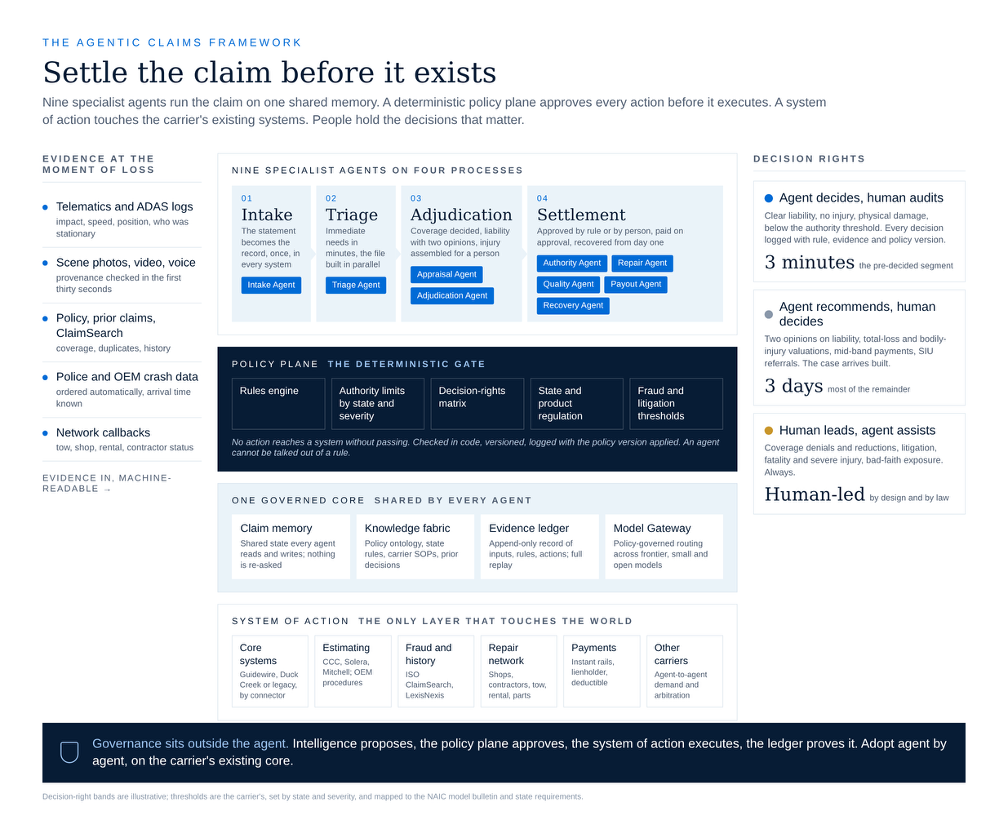
Figure 2. The Agentic Claims framework. Evidence arrives machine-readable; nine agents on four processes propose; the policy plane approves; the system of action executes; the ledger proves it. Decision rights decide which clock a claim runs on.
Every part of this exists today. A digital carrier already pays some claims in seconds. A top-five US carrier runs a fully agentic voice agent for auto first notice nationwide. One in four repairable estimates is written from photographs, and instant payment rails are standard. What is new is the assembly: one chain, one memory, one gate, and a decision taken before the claim arrives. 180 seconds are twelve to fourteen model calls; the longest stage, adjudication, is thirty seconds.
The path is code, not prompts. An agent cannot be talked out of rules.
Three rules keep the speed honest. The gate is code, not a prompt: limits and denials are enforced before execution, in a policy plane the agent cannot reason its way around. Doubt goes to people: below a confidence threshold or above an authority limit, the claim lands on an adjuster's workbench with the case already built, not in a queue. And denials are always human. That last rule is not a concession to regulators; it is what New Jersey, Colorado and the NAIC model bulletin are writing into law in 2026, and it is what makes a three-minute claim survivable in a market-conduct exam.
Who decides what


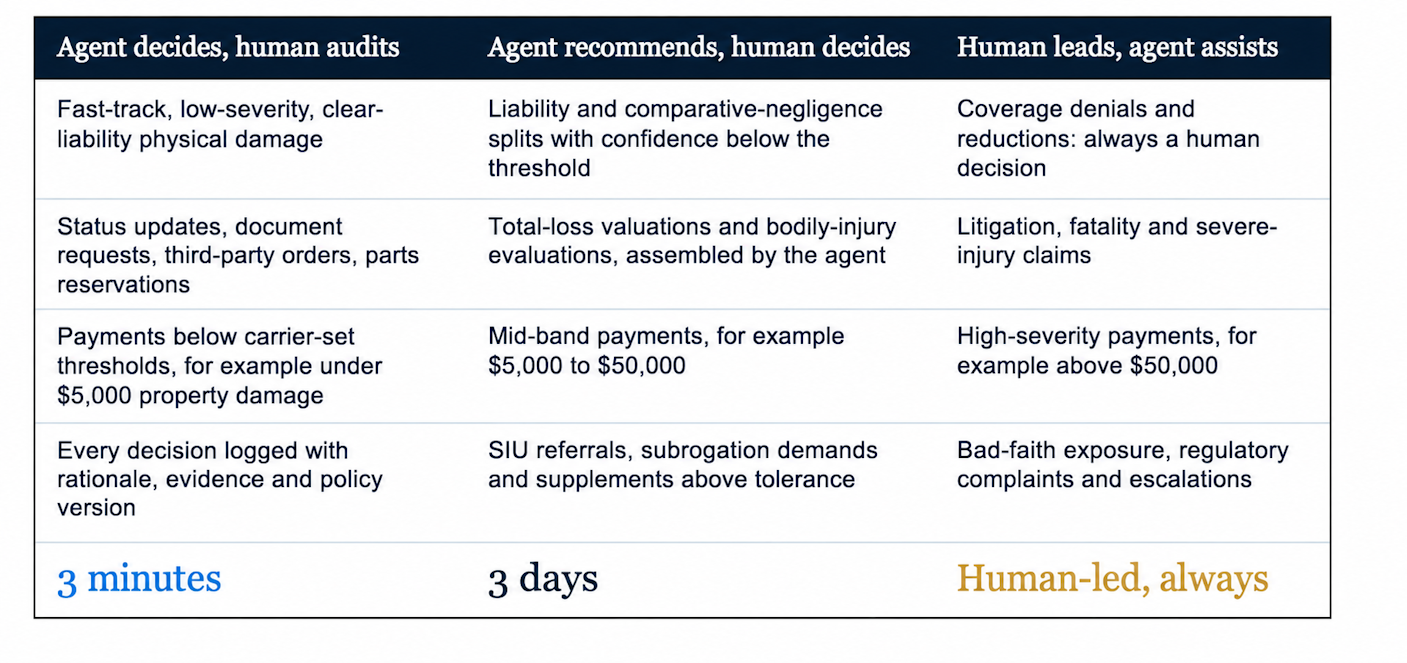
Thresholds are the carrier's, set by state and severity, and auditable. Mapped to the NAIC model bulletin and to Colorado, New Jersey, New York and California requirements. The segment that settles in three minutes is the first column, and only the first column.
The three minutes are a segment, not an average. Doubt goes to people, with the case already built.
03 — The outcome


What changes when the claim is decided first
Start with the customer, because the carrier's outcomes follow from theirs. A car claim is an inconvenience. A home claim is a broken door at eleven at night, a flooded kitchen, a family deciding where to sleep. The same nine agents and the same governed core carry over to property; what changes is the evidence, the estimating, the settlement mechanics and the urgency. The clock that matters is measured in hours.


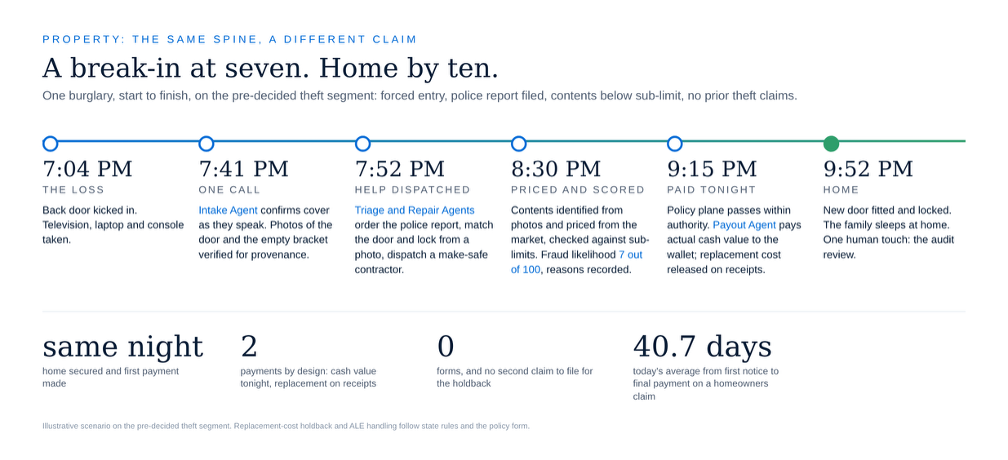
Figure 3. One burglary on the pre-decided theft segment. Make-safe first, contents priced from the market, fraud scored in the open, actual cash value paid the same night and replacement cost released on receipts.
Convert a customer to a lifelong client. A carrier that secures the home, replaces what was lost and pays before the family goes to bed has done something no premium discount can buy.
For the carrier, the outcome is measured in four places. Expense: the handoffs are the cycle time and the cost, and removing them takes twenty to thirty percent out of loss-adjustment expense. Leakage: duplicate-pay controls, subrogation opened at settlement rather than after close, and supplements checked against the approved estimate recover a fifth to two fifths of what leaks today. Fraud: provenance checks on every image and document in the first thirty seconds, and a fraud score with its reasons recorded, released in the customer's favour when low and routed to a person when high. Auditability: every decision carries the rule it applied, the evidence it relied on and the policy version in force, so the market-conduct exam becomes a replay rather than a reconstruction.
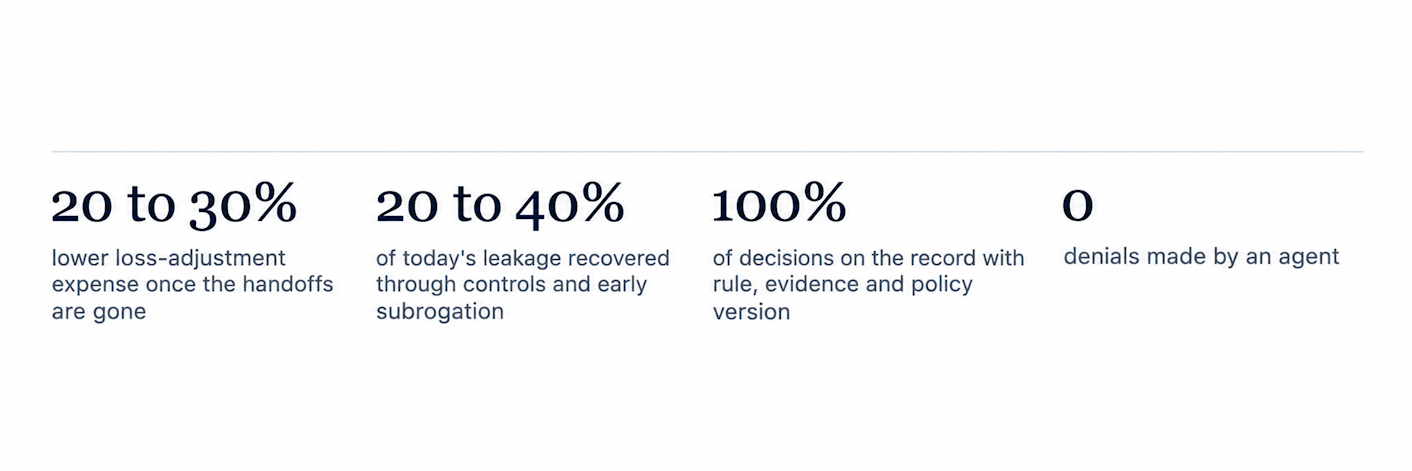
On a ten-billion-dollar auto book, the reconciled model lands at $350 to 450 million of annual benefit at maturity, three to five points of combined ratio, for an investment of $60 to 90 million over thirty-six months and payback in eighteen to twenty-four months. Retention and litigation avoidance are held as upside and not counted. The numbers are illustrative and deliberately conservative; the first design partner will replace them with measured ones.

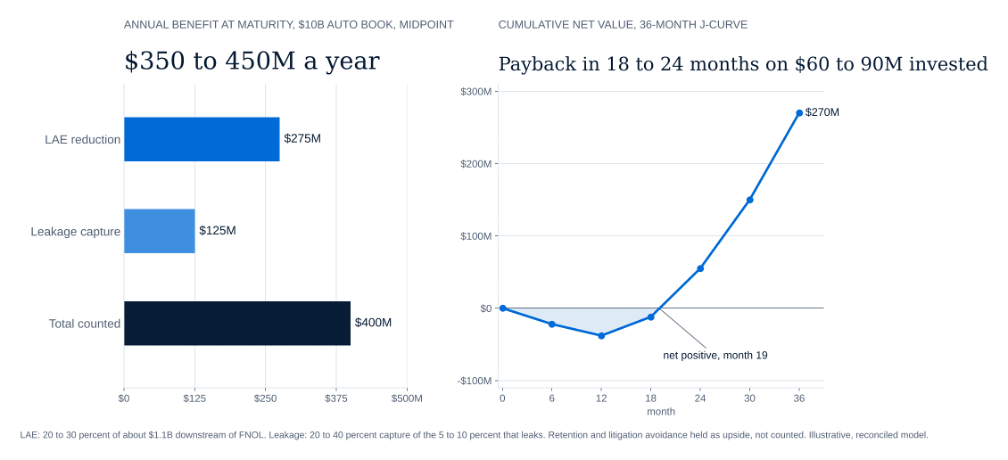
Figure 4. The value case for a $10B auto book. Two components counted, two held as upside, and a J-curve that turns positive around month nineteen.
Speed is defensible only because every action was checked before it ran and can be replayed after.
04 — Why NTT DATA


The whole chain needs an operator
Core platforms automate inside their own box. Claims insurtechs add one step. Carriers below the top five cannot staff an eight-component programme on their own. The three minutes are mostly integration and operations, not models, and that calls for a particular kind of partner.
We run claims operations: we operate the human-in-the-loop layer as a service and price the result per claim, not per seat. A software vendor cannot sell an outcome, and a systems integrator without operations cannot stand behind one. We own the integration: telematics, estimating, document stores, ClaimSearch, parts, payments and the core system wired into one event-driven chain is the work, and core modernization is what we do every day. We are neutral: Azure and AWS, models routed per task across frontier, small and open, Guidewire, Duck Creek or legacy, so the carrier keeps its options where a platform's native agents would lock the roadmap. And we have built the pieces. Agentic FNOL is delivered. Intake-to-adjudication support is running at a large North American P&C carrier. Claims document intelligence is in production at a top-tier P&C group. A policy-governed model gateway is being adopted enterprise-wide by a global multi-line insurer. No incumbent carrier has stitched them into one decision. We have the parts to.
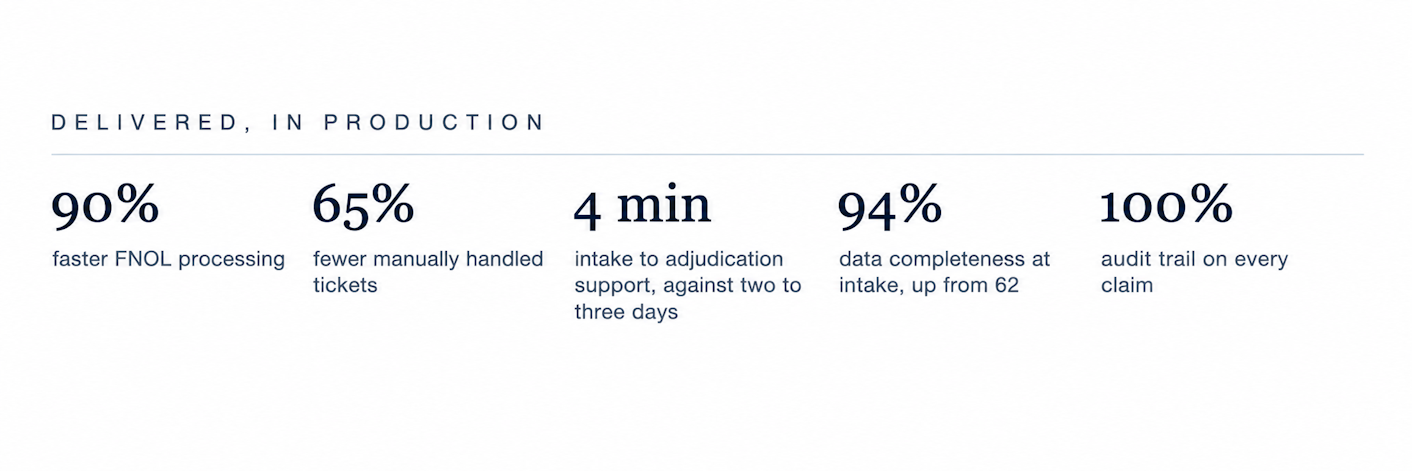
No incumbent carrier has stitched intake, triage, adjudication and settlement into one governed decision. That is the gap.
Where it leads
Begin with claims
Claims is the fastest, lowest-risk path to becoming an agentic insurer, and the spine that learns to prevent the next loss. Every settled claim feeds fraud, pricing and underwriting within days; the telematics that settle crashes increasingly pre-empt them. The best claims organisation of 2030 handles fewer claims, and the carrier shifts from paying for losses to preventing them.
The path is short to describe. Decide the segment and the decision rights first. Stand up one governed decision spine. Prove it on one segment with one design partner in ninety days, shadow mode then live, with exit criteria of segment accuracy, zero unexplained agent actions and cycle time. Then scale agent by agent, and carrier by carrier. The carriers who build the spine now get to play in 2030.
The claim settled before it exists.
Agentic Claims for P&C, from NTT DATA.
Sources: Verisk and APCIA, S&P Global Market Intelligence, CCC Intelligent Solutions, LexisNexis Risk Solutions, J.D. Power, Triple-I and the Casualty Actuarial Society, Insurance Research Council, Verisk State of Insurance Fraud, Sedgwick, Jacobson Group, US Bureau of Labor Statistics, NAIC, state legislative records, company filings and announcements, and NTT DATA delivery experience. Value figures are illustrative for a $10B auto book.
Related content



Post / Insurtech's turning point: from innovation hype to industrial impact
The Insurtech Global Outlook 2026 shows how insurers are scaling AI, data and ecosystems to turn innovation into business impact.


Post / From insight to execution agentic AI for insurance
Explore how insurers can move from insight to execution with agentic AI. Download the Everest Group paper, supported by NTT DATA.

Post / Turning Mobility Data into Insurance Value and New Ecosystems
How mobility data, AI and SDVs are reshaping insurance, from risk modeling to new ecosystem-driven services.





Subscribe to Our Newsletter
Get the latest insights about Global solutions for leading insurers on your email